Why Wall Cracks Worry Home Buyers — and Surveyors
Cracks in walls are one of the most common concerns raised by property buyers in Wolverhampton. When you walk through a property and spot a crack running across the plaster, your heart might sink. But as experienced RICS surveyors, we can tell you something reassuring: the vast majority of cracks we see in Wolverhampton properties are completely harmless.
That said, some cracks are a warning sign of serious structural problems — subsidence, settlement, or movement that needs urgent professional attention. The difficulty for the untrained eye is knowing which is which. In this guide, we'll walk you through exactly what our surveyors look for when they inspect wall cracks, what different types of cracks tell us, and when you should be genuinely concerned.
Key takeaway: A crack in a wall is never "normal" — every crack has a cause. The question is whether that cause is serious or benign. A professional building survey by an RICS surveyor is the only reliable way to know for certain.
The BRE Crack Classification System
In the UK, surveyors use the Building Research Establishment (BRE) crack classification system (from BRE Digest 251) to categorise cracks according to their severity. This gives a consistent, professional framework for assessing damage. There are six categories:
| Category | Description | Typical Width | Severity |
|---|---|---|---|
| 0 | Hair-line cracks in plaster | <0.1mm | Negligible |
| 1 | Fine cracks, easily filled | <1mm | Very slight |
| 2 | Cracks which can be easily filled but may recur | <5mm | Slight |
| 3 | Cracks requiring opening up and patching | 5–15mm | Moderate |
| 4 | Extensive damage; windows/doors distorted | 15–25mm | Severe |
| 5 | Structural instability; requires major repair | >25mm | Very severe |
Categories 0, 1, and 2 are generally not a cause for concern. Categories 3 upwards warrant investigation, and categories 4 and 5 require urgent professional assessment.
Types of Wall Cracks and What They Mean
1. Hairline Cracks (Category 0–1)
These are extremely common in all types of property — particularly in plasterwork and paint. They are almost always caused by normal thermal movement (walls expanding and contracting as temperatures change), shrinkage as plaster dries, or minor settlement of a new build. In Wolverhampton's Victorian terraces, hairline cracks in plaster are essentially universal. They mean nothing in themselves.
2. Diagonal Cracks at Door and Window Corners (Category 1–2)
A common sight in older Wolverhampton properties — particularly those with plastered brickwork. These typically run diagonally from the corners of door or window frames. They are usually caused by thermal movement or minor settlement, and are rarely serious. However, if they are wide, active (still growing), or accompanied by door/window sticking, a surveyor should investigate further.
3. Horizontal Cracks in Brickwork (Category 3–4)
Horizontal cracks running along the mortar course between bricks — particularly in older properties — are more concerning. They can indicate lateral movement, often caused by the outward spread of roof timbers pushing the wall, or problems with the structural integrity of the wall itself. This type of crack warrants investigation by a structural engineer or RICS building surveyor.
4. Step-Cracking in Brickwork (Category 2–4)
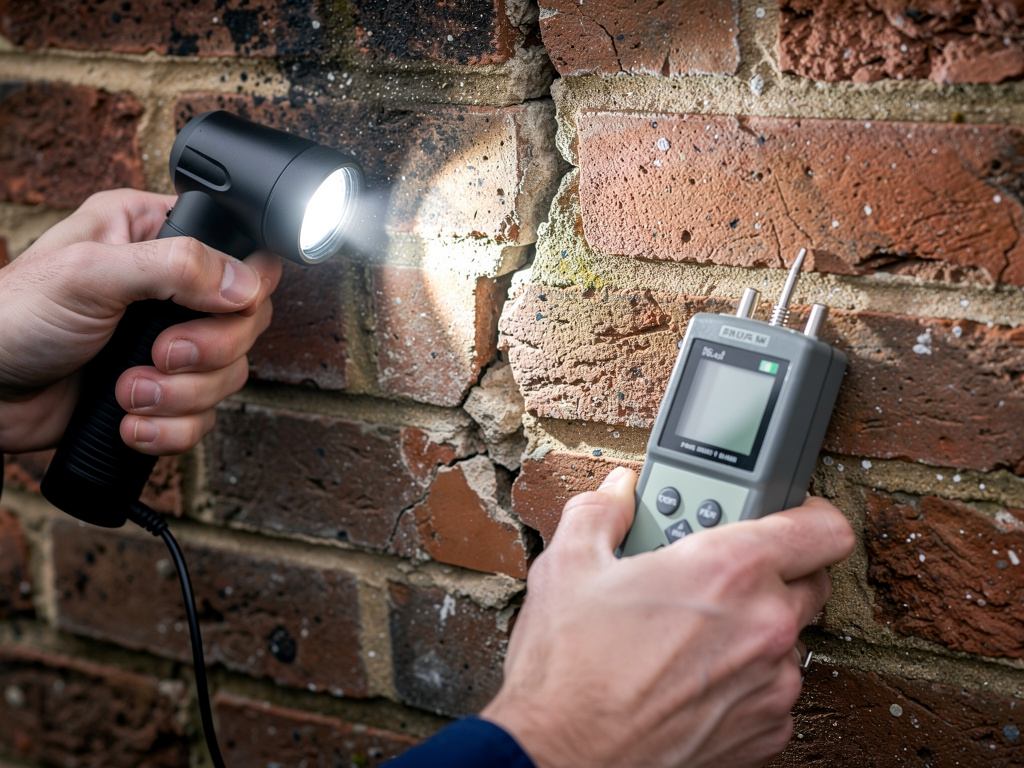
Step-cracking — where the crack follows a stepped pattern along the mortar joints between bricks — is one of the most commonly asked-about crack types we encounter on surveys in Wolverhampton. It can indicate differential settlement or subsidence, particularly if one side of the crack has dropped relative to the other. The severity depends heavily on the width, whether the crack is active, and whether there is any vertical displacement between the two sides. Minor step-cracking in an old wall may simply reflect normal settlement over many decades.
5. Vertical Cracks in Walls (Category 2–5)
Vertical cracks can have various causes. In cavity walls, they may indicate wall tie failure — a significant structural issue common in properties built between the 1930s and 1970s in Wolverhampton. Wide vertical cracks in external brickwork, particularly those that taper or have displacement, should always be investigated by a professional.
6. Cracks Around a Chimney Breast
Cracks radiating from or around a chimney breast are common in Wolverhampton's older housing stock. They can result from thermal cycling of the chimney stack, settlement, or — more seriously — movement or partial removal of the chimney breast without adequate support. This is a particular concern in properties where conversions have taken place.
Subsidence: The Most Feared Cause of Cracks
When homeowners see cracks, subsidence is often the first thing that springs to mind. Subsidence occurs when the ground beneath a property's foundations starts to sink, causing the building to move and crack. It is one of the most serious — and expensive — structural problems a property can have.
In Wolverhampton and the wider West Midlands, subsidence risk is elevated in several areas due to:
- Former mining activity — the region has an extensive mining history that can affect ground stability
- Clay soils — which shrink in dry weather and expand when wet, causing seasonal movement
- Tree root activity — particularly in properties close to large trees on clay soils
- Leaking drains — which erode soil beneath foundations over time
Subsidence cracks typically have certain characteristics that distinguish them from more benign types:
- Diagonal, wider at the top than the bottom (or vice versa)
- Visible both internally and externally
- Associated with doors and windows sticking or jamming
- Active — continuing to grow over time
- Accompanied by sloping floors or visible differential movement
However, it's important to note that not all diagonal cracks indicate subsidence. Many Victorian and Edwardian properties in Wolverhampton have experienced natural long-term settlement and show historic cracks that have been stable for decades. A skilled RICS surveyor can usually differentiate between historic settlement and active subsidence.
Wall Tie Failure in Wolverhampton Properties
Wall tie failure is a significant structural issue that affects a large number of cavity wall properties built between the 1930s and 1980s — a period that accounts for a considerable portion of Wolverhampton's housing stock.
Cavity walls use metal ties to connect the inner and outer leaves of the wall. Over time, particularly in the era before stainless steel ties were standard (roughly pre-1981), these ties corrode. As they rust, they expand and can cause horizontal cracking at regular intervals along the mortar courses — typically every fifth course (corresponding to the spacing of the ties). If left untreated, wall tie failure can lead to the outer leaf of the wall becoming structurally unsound.
Wall tie failure is identified during a survey using visual inspection and, where appropriate, a borescope camera to inspect the cavity. It can be remedied by installing new stainless steel spiral ties — a specialist job but a manageable one if caught early.
What a Surveyor Will Do When They Find Cracks
When our RICS surveyors encounter cracks during a property inspection in Wolverhampton, the process is systematic:
- Classify the crack using the BRE system — noting width, length, pattern, and location
- Assess whether the crack is active or historic — looking for freshness, displacement, and whether previous repairs have re-opened
- Consider the context — property age, construction type, local ground conditions, nearby trees, and drain locations
- Inspect related elements — checking doors, windows, floors, and external brickwork for associated movement
- Report findings clearly — using the traffic-light rating system in the RICS Home Survey, with a plain-English explanation of significance and recommended next steps
- Recommend further investigation where necessary — this might include a structural engineer's report, a drain CCTV survey, or simply monitoring over time
How to Monitor Cracks Yourself
If you are concerned about a crack in your current home — or want to monitor a crack in a property you are buying — there is a simple method used by surveyors:
- Mark the ends of the crack with a pencil and date your marks
- Place a tell-tale (a small plastic gauge available from DIY stores) across the crack
- Photograph the crack regularly with a scale reference
- Check after 3, 6, and 12 months — noting any change in width or length
If the crack shows no change over six months or more, it is likely historic. If it continues to grow, seek professional advice promptly.
When to Get a Professional Survey
You should arrange a professional inspection by an RICS surveyor or structural engineer if:
- You are buying a property with visible cracks, particularly if they are wide, diagonal, or step-cracking in brickwork
- You have cracks wider than 5mm in your current home
- Cracks are accompanied by sticking doors or windows
- Cracks appear to be growing or have returned after being filled
- You have horizontal cracks in external brickwork
- You're in an area known to have mining history or clay soils
Frequently Asked Questions About Wall Cracks
No. Diagonal cracks are very common in older properties and are often caused by thermal movement, settlement over decades, or shrinkage — none of which are serious. Subsidence cracks have a distinct combination of characteristics: they tend to be active, wide at one end and narrow at the other, visible both inside and out, and are accompanied by other movement signs like sticking doors. An RICS surveyor can usually distinguish between the two.
Repair costs vary enormously depending on the cause and extent. Minor subsidence caused by tree roots or leaking drains — once the source is resolved — may involve relatively modest underpinning costs. Significant underpinning of a large property can cost anywhere from £5,000 to £50,000 or more. Most buildings insurance policies cover subsidence, though you should check your excess and policy wording carefully.
It depends entirely on the severity of the cracks and the lender's risk appetite. Minor cracks that a surveyor rates as category 1 or 2 are unlikely to affect mortgage eligibility. More serious cracks may result in the lender requesting a specialist structural survey or report before they will lend. In some cases of severe subsidence, some lenders may decline. Getting a thorough survey before exchange gives you and your lender the information needed to make an informed decision.
A tell-tale is a simple plastic device that is glued across a crack. It has a graduated scale printed on it, allowing you to measure any change in crack width over time. If the crack is static (not growing), the tell-tale shows no movement. If the building is still moving, the tell-tale will register the change visually. Surveyors sometimes fit tell-tales as part of a monitoring programme on properties where they suspect active movement.
Yes. Under the Property Information Form (TA6), sellers are required to disclose any known structural defects, including significant cracking. Failure to disclose known defects can expose sellers to claims for misrepresentation. If you are aware of serious cracking — particularly if it has been investigated and documented — you are legally obliged to declare it.
Conclusion: Don't Panic, But Don't Ignore
Wall cracks are one of the most frequently encountered survey findings in Wolverhampton properties — and the vast majority are nothing to worry about. Every Victorian terrace, every post-war semi, every 1960s estate will have some degree of cracking after decades of thermal movement and natural settlement.
The key message is this: don't panic when you see a crack, but don't ignore it either. Get a professional building survey before you buy — and if you're already in a property with a crack you're concerned about, speak to an RICS surveyor who can assess it properly.
At Wolverhampton Surveyors, we inspect hundreds of properties every year and understand the local housing stock intimately. Our RICS Level 3 Building Survey is the most thorough option for older or potentially problematic properties, while our Level 2 HomeBuyer Report covers cracks and structural issues for more conventional properties. Contact us today for a free, no-obligation quote.

Concerned About a Property?
Get a professional RICS building survey from Wolverhampton Surveyors. We'll assess every crack, defect, and structural issue — and tell you exactly what it means for your purchase.
Related Articles
Damp & Mould: What Does a Surveyor Look For?

Level 2 vs Level 3 Survey: Which Do You Need?